For our groups final project, we are presenting on the evolution of the Jackbox Party Packs. It is fascinating to see the mechanical differences driving these large-group party games and exactly what goes into developing a game that supports large player counts.
We’ve found that each party pack consists of games that have similar design patterns. Trivia is a common theme you would find in a lot of Jackbox titles. These design patterns are generally chosen to support large party layouts. For example, a competitive FPS probably isn’t something you would find in the Jackbox Party Packs and for good reason. Competition is not very conducive with large player count titles or party games. Trivia, however, is something any large group can participate in readily.
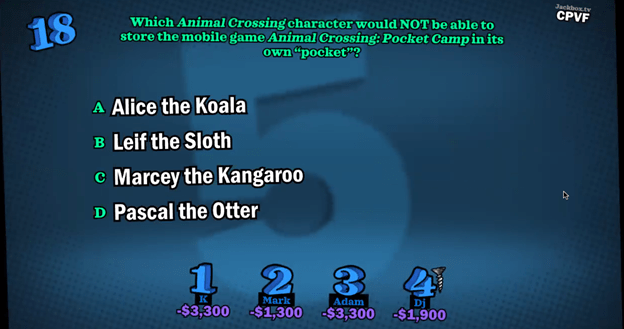
Your typical session of You Don’t Know Jack from Jackbox Party Pack 5.
Beyond the content of these packs, it is interesting to observe the reception of these titles and just how successful they are. Why is it these games have become so successful? Jackbox Party Pack strives in providing players with an assortment of accessible mini-games hosted by one player. In doing so, these games create a great jump in and play party environment with some hit-or-miss titles. Our presentation will go even further in depth on this, including the critical reception, sales, marketing tactics and more.
At the end of the day, Jackbox Party Packs have captured a market that many other video games fail to grasp. Accessible casual mini-games that are a good time, all offered at reasonable prices and presented in a convenient package for players. It is no surprise these titles have found success and evolved to further player experience.
The Friday session included three different Jackbox games, each with their own unique set of mechanics that allowed a large group of us to play them together remotely. The session was a ton of fun and by looking further at these Jackbox games, we can gain some insight as to how these large party games function with multiple players to create a unique playing experience for everyone involved.
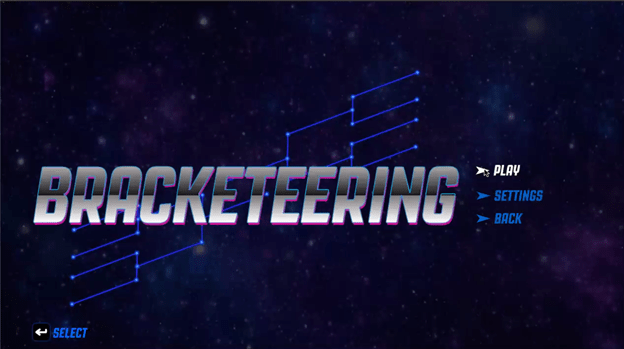
The first of the three titles we played, Bracketeering, is a competitive game where players compete in a tournament-style bracket to answer a question in the most humorous way for the entire group. Players with the most voted for answers receive points, with which the player with the most wins the tournament. Mechanics of this game include tournament-style competition, points, voting systems and prediction. One interesting part of Bracketeering was the dynamic that occurred in which everybody sought out the highest quality “meme material” to increase their chances of earning points and making other players laugh. The game has a great sense of humor and an engaging UI paired with a corny announcer that comes together to form a fun experience for large parties.
The second title played was Trivia Murder Party, a rather dark game of trivia with the twist that players can die. The game functions with rounds in which players who fail to answer trivia questions correctly are faced with SAW-inspired challenges that often includes audience interaction. Observers in the audience can often make challenges more difficult for certain players or even compete with the players directly to win the game. Mechanics of Trivia Murder Party include round-based structure, time-restrictions, player lives, audience interaction and trivia to name a few. One interesting dynamic that emerged from playing the game was the heavy incentive to sabotage other players in an effort to improve your chances at winning the game. The dark humor of this type of game probably isn’t for everyone but for the right group of players it can be a great time.
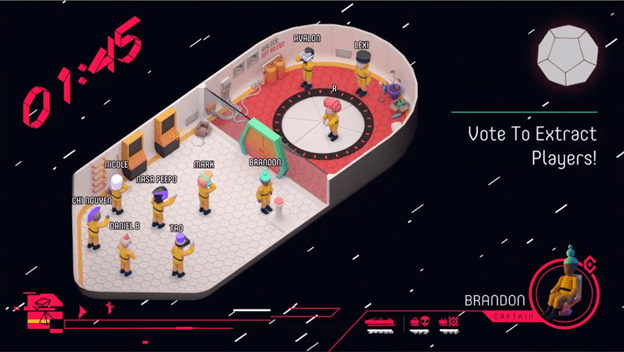
The last part of our play session included Push the Button, a sci-fi themed detective game in which the human players seek to deduce a group of aliens out of the group in an effort to eradicate them from a self-destructing ship. Humans work together by subjecting one another to various challenges in an effort to figure out who are the possible aliens while aliens secretly work together via hacking to conceal their trail and make the job of the human team all the more difficult. Mechanics for this title include race-against-the-clock, minigames, detective, teamwork, deception and communication. Ultimately our group could not decide on a trio of aliens and were even bamboozled by some clever alien teamwork that helped conceal one of the alien’s identities all the way to the very end.
Overall Jackbox games were a fun experience that our group will continue to explore in the final project and analyze in a more formal way.
As the development for the Beta of Bubble Blitz came to a close, I couldn’t help but be extremely proud of what we have made. It’s not super complex and it’s definitely not anything unique but starting from nothing and building it from scratch was an incredible experience.
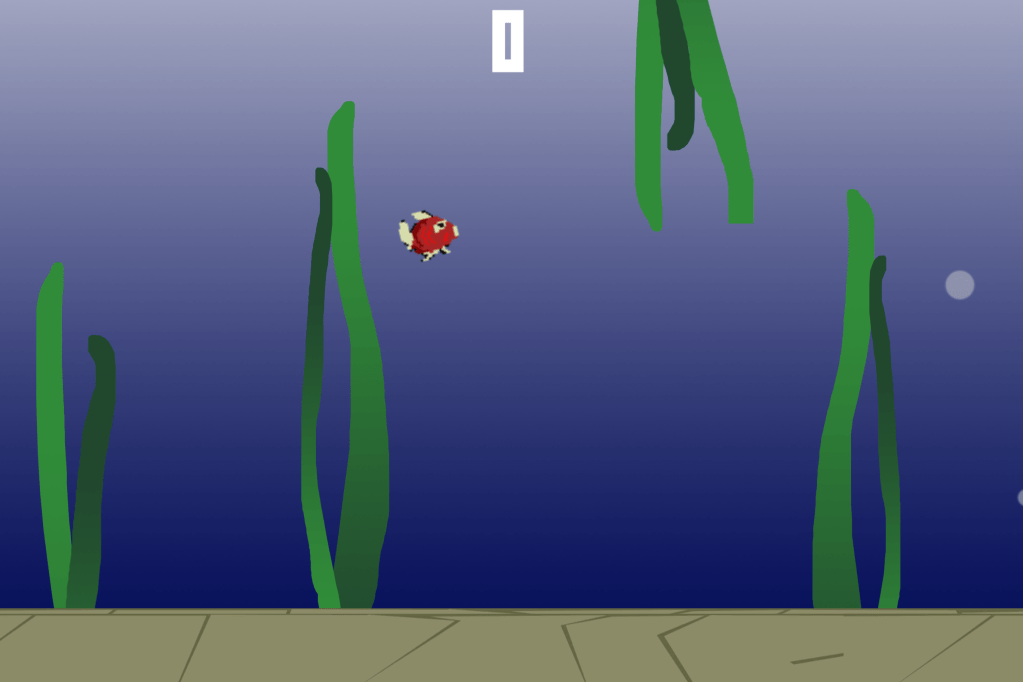
The finished prototype of Bubble Blitz.
The game is a simple concept of clicking (or using spacebar) to swim upwards and avoiding the coral obstacles. Landing inbetween the corals earns the player points! Swimming the furthest you can will see you earning a competitive high score that you can challenge your friends to beat. It is a simple premise that we developed from a humble beginning.
Coming out of the alpha, one of our primary focuses was the presentation of the game. We had mechanics in place but wanted to make the experience a more welcoming and interactive experience. SFX added for swimming, scoring and death definitely help add to the game. The additional artwork with the seaweed and the sea floor also definitely help add color to the scene! Parallaxing bugs for the other objects have been squashed and now bubbles finally behave like, well, kind of real bubbles. Thanks to the help of play testers, we were also able to fix some oversights by us such as adding a ceiling that prevents the player from swimming out of bounds. All in all we made a lot of progress from the alpha but there was also a lot more we would like to put in the future.
Unfortunately we had to cut the enemy AI shark due to time constraints but I would definitely like to put time into implementing the shark in the future. I also would’ve really liked to see some background music in our game but the music I had in mind is licensed by Disney, so we figured it best to leave that out for the beta release. In the future, we would hope to add these features and also add alternate scoring modes such as distance instead of points in preparation for a 1.0 release!
Game: Coral Catastrophe Programmer: Devin Gonzales Artist: Daniel Balducci
At the end of the day, the only way to understand game development is to begin development of your own. Acting as our programmer and paired with an artist, we were prepared to build our own small endless-runner title in Unity. We wanted something replayable, fun, simple and easily portable to mobile and one of the first titles we drew inspiration from in these regards was the unforgettable Flappy Bird. We set out to put our spin on this simple runner with a fish instead of a bird. The idea was to have the player swim towards the end while avoiding an AI shark, with the goal of gaining the highest score. I set out to begin writing the game mechanics while my artists began work on the assets.
It turns out the process to develop even a small game is a little more difficult than you might think. Surprisingly enough a lot of my trouble was not with the code but with the Unity editor itself. I began with the simple mechanics such as the physics of the swimming fish and moved my way upwards towards the more complex components of the game. Of these, the script that ran the parallax movement was the most difficult. Some time after I begin writing it I was in a war with bugs that made Starship Troopers look benign. With a little elbow grease and several cups of coffee, the first playable prototype was in sight.
First playable prototype gameplay of Coral Catastrophe
Once the code was written and the art was imported, it was time to tweak the game mechanics. A big part of designing our mechanics was centered around difficulty and ensuring the player had a good time playing the game while also not growing bored. I ensured the collision-box for our fish hugged the sprite as closely as possible but also left some generous room for mistakes. Next up was adjusting the velocity of obstacles moving “towards” our fish, such that the player isn’t bombarded with a series of obstacles that require super-human reactions to win. At long last with our art in place, mechanics created and adjusted, our first playable prototype was ready to go for testing.
Players reacted well and definitely picked up on our inspiration. I was really surprised by some of the they caught that, while obvious in hindsight, didn’t cross our minds in development. Many players caught onto the fact that they could swim out of bounds vertically. Some also suggested many ideas we have planned, such as steadily increasing difficulty and inclusion of audio/sound effects. All in all we are excited to continue development on this title after this feedback and hopefully get a working version for Android and iOS!
Challenge is an interesting design approach that many developers struggle to flesh out in a way that betters their projects. In this post we’ll be diving into two games that nail the challenge aesthetic and compare how it benefits both titles in a similarly beneficial way.
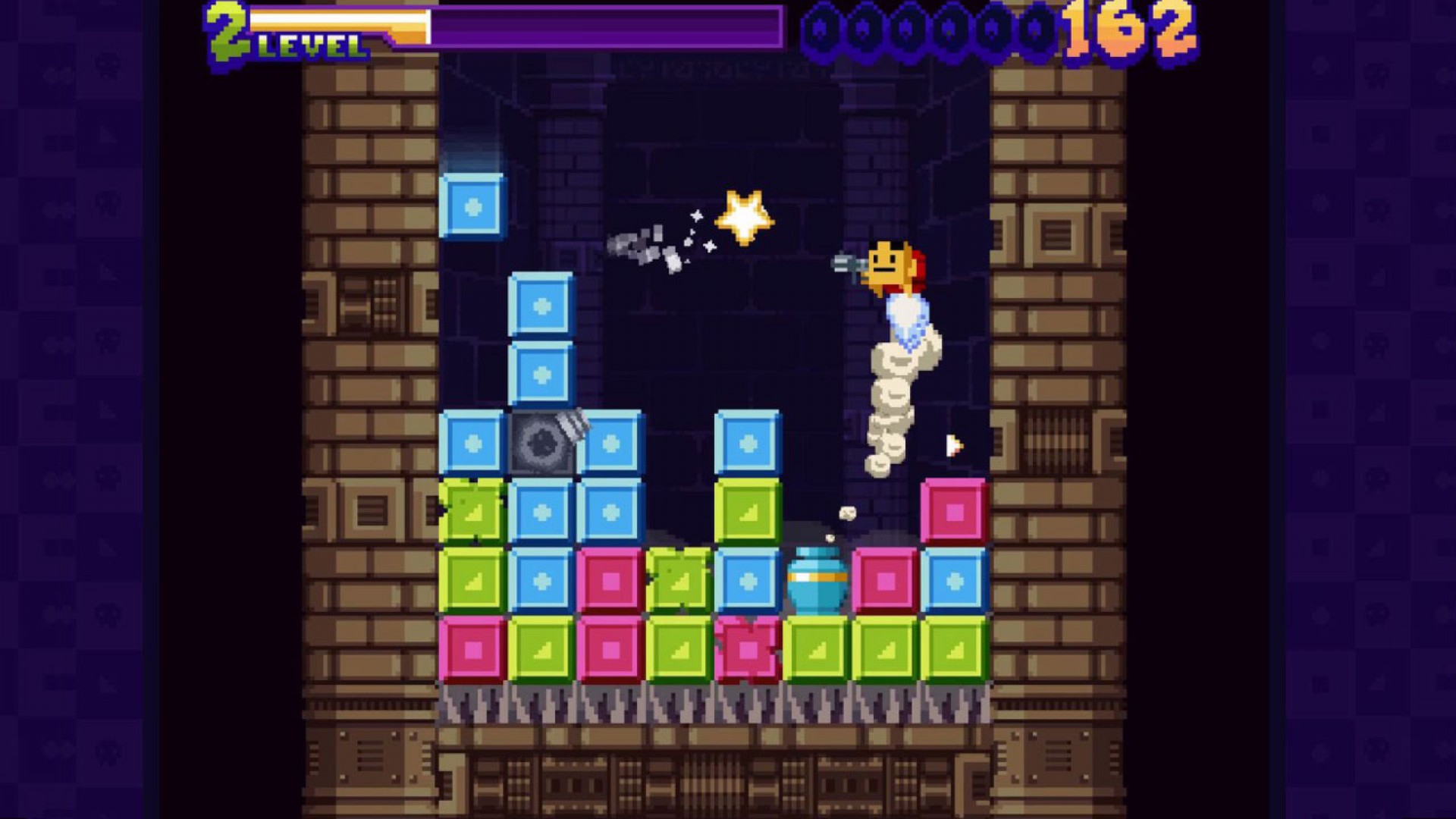
The first title we’ll look at is Super Puzzle Platformer. SPP brings forward an excellent twist on the matching color/grouping mechanic introduced by more recent titles like Candy Crush. It provides us with a colorful aesthetic that is a refreshing take on retro classics like Tetris where instead of controlling the falling blocks, we control the mechanic that consumes the grouped up blocks in the form of the player character. The game centers around challenge by providing the player with an increasingly difficult obstacle course in navigating falling blocks and traps.
Another title designed around challenge is This is The Only Level. In contrast to the previous title, this game uses challenge other ways. Each stage changes the input of controls and the win condition. One stage, in particular, the win condition was to literally smash the left and right keys for the player token to move forward and meet the win condition! I really enjoyed how challenge in this title was gauged through puzzling win conditions and hidden control schemes but it felt fair due to the hints always given. Definitely a unique game worthy of recommendation in the way it attempts challenge.
While playing This is The Only Level enlightened experiences about it’s purpose, observing revealed an entire different set of challenges. Observation is an interesting part of game development in that you notice things you might not otherwise when you’re partaking as a player. My partner quickly caught on to each gimmick during each level and adapted their strategies accordingly. I immediately noticed that playing a game is significantly different then observing a player in that your hypotheses immediately get tested as a player. While both experiences test your knowledge as a player, both offer difference advantages towards being an observer or a player that can benefit your grasp on the mechanics. At the end of the day, the player that participates the most seems to have the greatest grasp on mechanics of a title and I look forward to the future tests we have on game titles.
Core Mechanics: Hand Management, Race, Grid Movement, Interrupts, Rock-Paper-Scissors
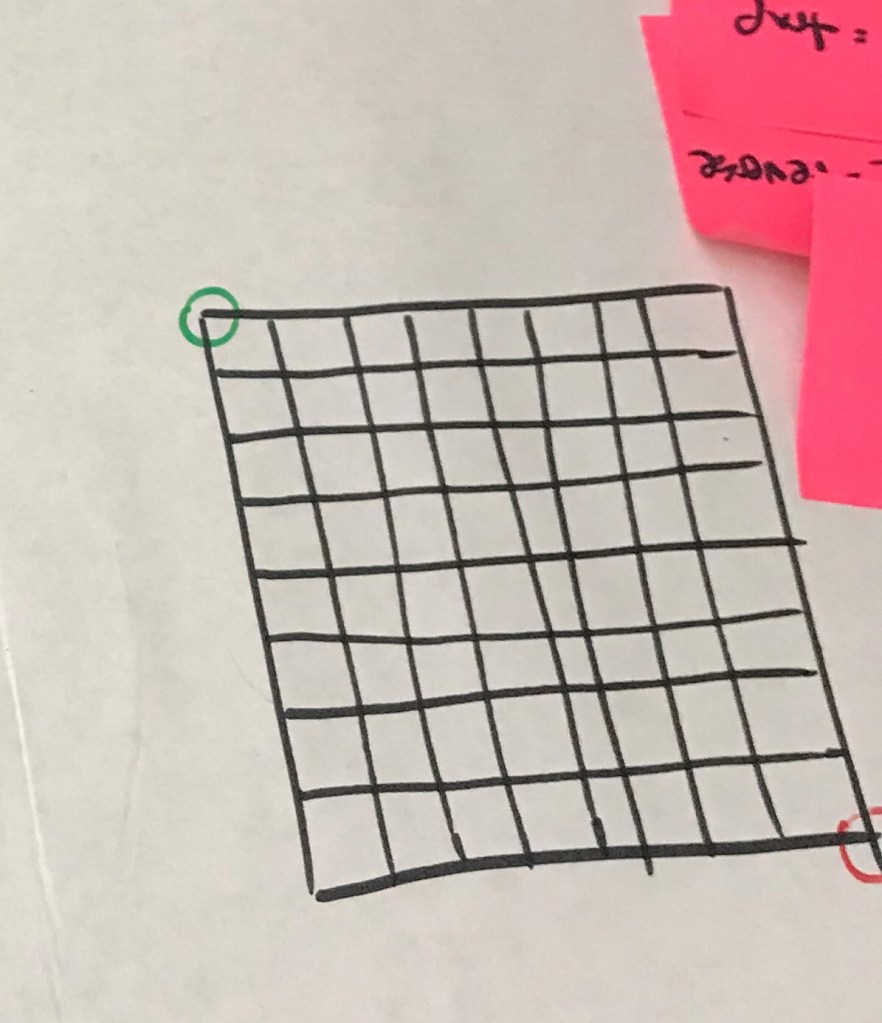
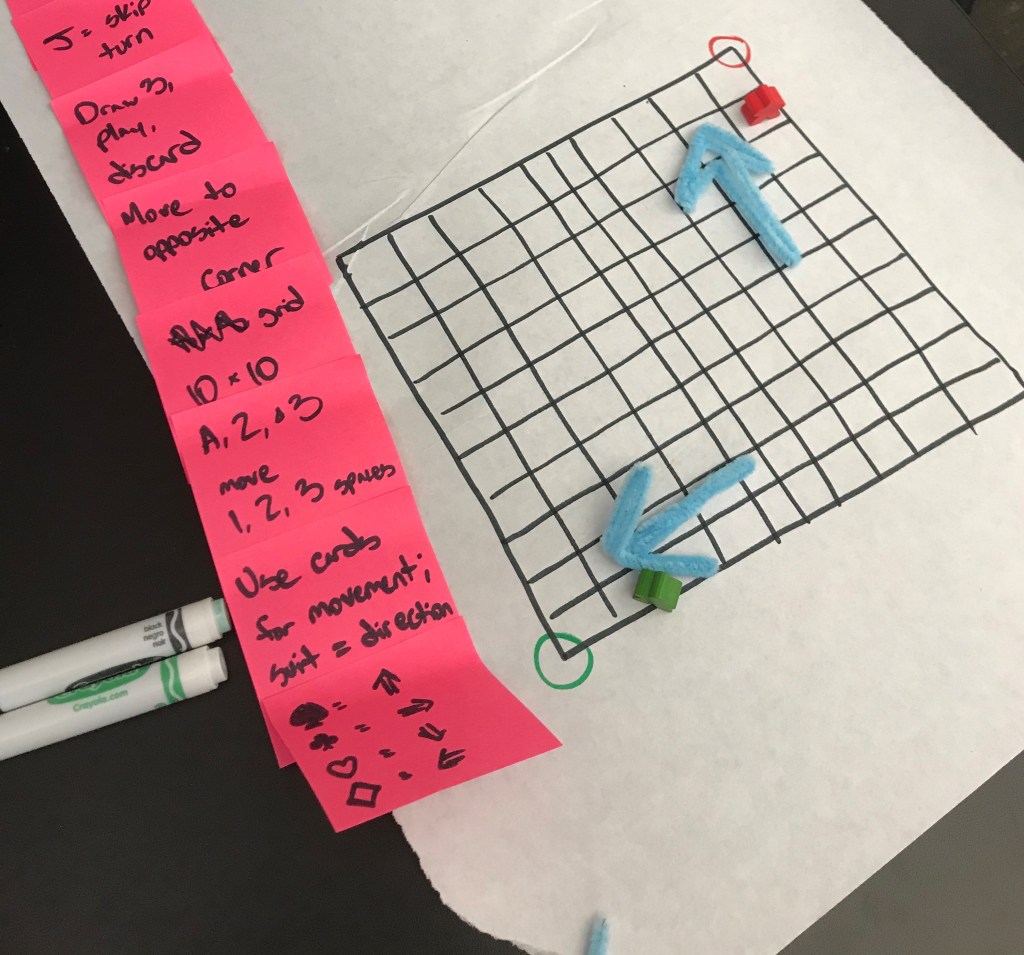
Our prototype began with a very humble concept. Two players start the game with their playing pieces on the opposite side of a 8×8 square board. Both players begin by drawing 1 card and the player with the highest card goes first. They use a filtered deck containing aces, twos, and threes to move their pieces across the board. Each suit of the card determines your direction of travel, with each of the 4 cardinal directions corresponding to one of the four suits. The goal is to get your piece to the other opponents start position first. We started with this concept and by the end of the session realized that while the game was functional, it was also really boring.
Prototype: Iteration 1
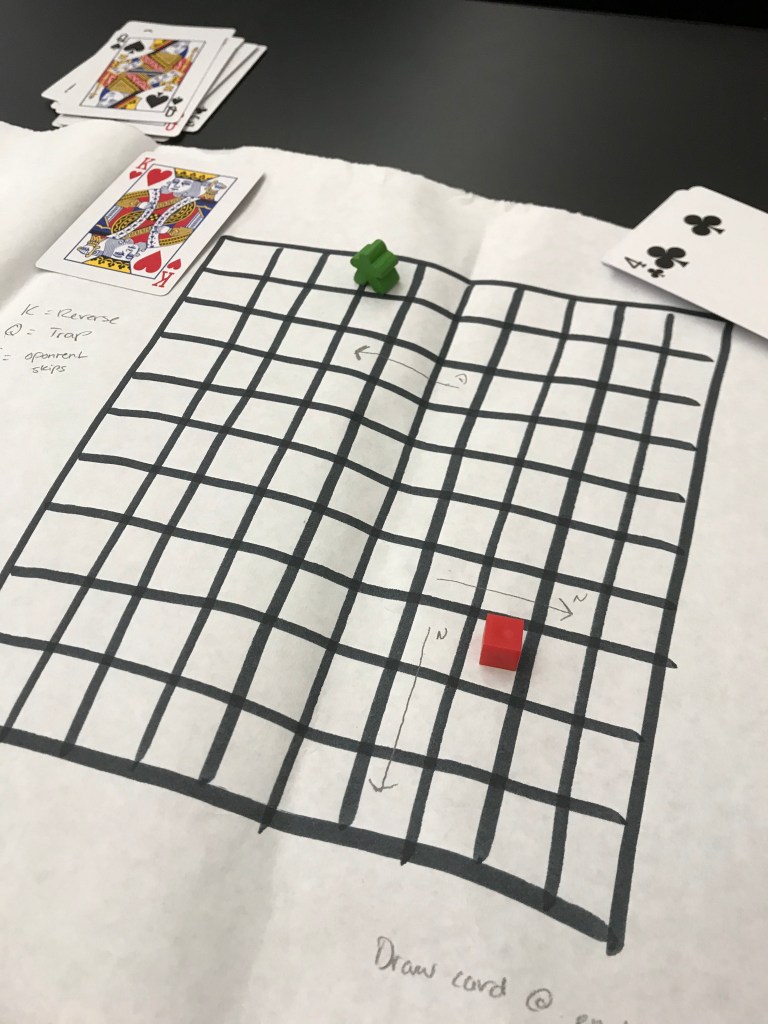
So for session 2 we focused on adding mechanics that introduce more conflict to the player. Enter face cards: we shuffled the 16 face cards into our filtered deck and gave each a purpose. Kings reversed the direction of movement for the board when played, queens allowed you to set a directional trap for the player on the board (represented by an arrow), jacks allowed you to sabotage an enemy player by skipping their turn. We also added a hand system in which during each turn, the player draws 3 cards and chooses to play one card from their hand to play. At the end of each players turn, they discard their 3 cards and redraw. For added fun, we also increased the size of the board to 10×10. The game was starting to take shape into something much more entertaining and it was here that I started to see the flaws in some of the most recently added mechanics.
Prototype: Iteration 2
By the last play session some of the flaws were beginning to show. My partner and I reached a situation where one player was in “checkmate”, unable to move their piece because the other player received multiple queens and essentially trapped their opponent. In hindsight, it really wasn’t smart to allow an unlimited amount of traps in play. So we added a rule that each player can only have 2 traps on the board. We also realized that re-drawing 3 cards for each player every turn really wasn’t that fun. So we instead decided that players would instead draw a single card every turn after playing one, while still maintaining a maximum hand of 3 cards. During this third play session, we also ran into a situation where the deciding draw for who should go first was a tie between both players! So we decided rock-paper-scissors would be the tie-breaker for which player takes the first turn if both of their drawn cards are of the same value.
Prototype: Iteration 3
Having finished the third session, I’m left with a more refined version of the original prototype. There is an elegance in the simplicity of this game that I really enjoy. While it’s not my favorite game ever, I had a lot of fun making it and even more fun sharing it with others. I look forward to potentially improving this prototype in the future and sharing it with others.
Another great introductory step into analyzing game development begins with one of the most fundamental types of games we can look at, boardgames. Our group played a couple games during this lab but the most entertaining and interesting by far was FLUXX.
FLUXX began for our group as a relatively simple card game with few rules. We understood the premise of play going into the game, that for each turn we play by both drawing a card and playing a card. I started the game off for us by playing a “Keeper” card War and then drawing. The next player in our table played a keeper of their own, Love. The table similarly continues to play keeper cards until one player, Sean, eventually sets down the first goal of the session cheekily titled: The Brain. By this point in the game, everybody is piecing together the win conditions quickly. There are cards known as keepers and cards known as goals. There names are fairly self explanatory in that keepers are necessary to reach certain goals. “The Brain”, for example, requires that a player have the keeper card Brain on the table without the card TV in order to win the game.
Connie introduces another new mechanic with the next turn with an action card titled Jackpot, allowing her to draw several cards in hopes of improving her hand. Action cards can provide a variety of advantages to a player, such as drawing new cards, shuffling the deck or even sabotaging other players. Our table comes to an unspoken understanding that action cards are going to be a pivotal part in playing this game well if we want to win. After another keeper enters play, Nicole introduces to the table the last major mechanic FLUXX has by playing the creeper card Werewolf and targeting Sean as her victim. Werewolf is a type of card that burdens whatever player owns it by not allowing them to win. It becomes clear to everybody playing that creeper cards are bad and playing them against people is how you lose friendships.
Examples of the types of cards in FLUXX.
Not too long after the creeper comes into play, another member of the table plays another goal card “Love Jesus“, which requires the keeper cards Love and Jesus to be in play for a player to win. This would mark the first time among many the win condition for the table would change. Every time one of us, myself include, would come close to winning someone would usually play a new goal card and its frustratingly back to square-one. As our session continues more rule cards rapidly start to come into play. “Hand Limit 1” handicaps everybody by limiting the number of cards they can own. “Party Time” meant any time the Party keeper card appeared, we would all draw extra cards. Pretty soon our game was loaded with all sorts of rules and the goal was constantly changing.
By the end of our session, nobody was close to winning. The rules compounded and the win condition constantly changed thanks to our various new goals coming in and out of play. At this point, I can safely say the best strategy to win a game of FLUXX is to have no strategy, which is the real beauty of this game. Planning ahead is impossible with the goal constantly changing. FLUXX is all about staying adaptive and responding quickly to the fleeting win conditions and opportunities that present themselves to you in the form of action and rule cards. Sometimes the best play you can make is to just horde some useful looking cards and hope you get lucky.
Before we can understand game development, it helps if we look at some examples of quality titles. Today we’ll be looking at the classic arcade title known as Root Beer Tapper.
My experience with Root Beer Tapper was pretty fun for the most part. The beginning can be a struggle, arcade mechanics aren’t all the straight-forward after all. Take, for example, the bar tenders ability to seemingly teleport to the tap stations. A mechanic that must be learned by the player and isn’t readily explained. Once I got the hang of the mechanics, I was enjoying my time. The expressive character models and animations as paired well with the catchy music. This is an absolute classic.
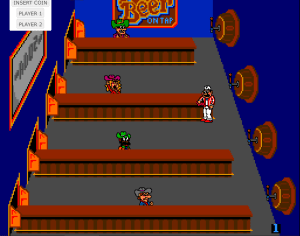
Every round begins with thirsty customers rowdy for root beer.
The game is easy in the beginning but it very quickly ramps up in difficulty, I made it to only round 4 before I was overwhelmed with thirsty root-beer drinkers. You’d be forgiven for speculating on the relative difficulty of these types of titles. Arcade games were intentionally designed to be difficult to get more coins out of players and also to extend the length of the game during a time where game development was limited to short and repetitive gameplay loops.
Playing on an emulator is actually awesome, it almost feels like cheating in some ways. You almost feel powerful being able to rebind control settings on your keyboard. I’m sure some prefer the novelty of playing on an original arcade machine but there are advantages to be had using the emulator, even if some of the game instructions are left a little confusing with respect to emulation controls.


 Dev's Game Dev